Sunday, July 25, 2010

Blog #4 7/24/10

NOAA Teacher at Sea: Story Miller

NOAA Ship: Oscar Dyson
Mission: Summer Pollock III
Geographical Area: Bering Sea
Date: July, 24, 2010
Time: 1837 ADT
Latitude: 62°11N
Longitude:177°52W
Wind: 15.1 knots (approx. 17.4 mph)
Direction: 156° (SW)
Sea Temperature: 8.3°C (approx. 47°F)
Air Temperature: 7.4°C (approx. 45.3°F)
Barometric Pressure (mb): 1007
Wave Swells: 4 - 5 feet
Wave Height: 1 - 2 feet
Combined: 5 - 6 feet

Scientific Log:
Today started out with the launching of another CTD (Conductivity, Temperature, Depth) and XBT to measure the salinity and temperature of the ocean. On average we typically deploy a little more than one per day, depending on whether we are wanting to hit key locations. Today when we launched two and contrasted locations where there were pollock to locations where there weren’t so we could better analyze how sea temperature affects where the pollock prefer to hang out.
Survey Tech, Robert Spina, taking samples from the CTD

We attempted to launch the Cam-Trawl this morning but as is typical with new equipment, we encountered some problems once it was in the water. And as my students have learned, sometimes it’s necessary to make modifications and try the science experiment again! Even the pro’s must go through the Scientific Method multiple times before they can publish their findings!

Ovaries of a female Walleye Pollock
At approximately 1030 we deployed the AWT and went fishing for more pollock. This time we were able to gather a variety of different ages between the years 1-3. Once the fish are dumped from the codend, they are placed on a type of conveyor belt that allows us to do a preliminary sort through the fish. For example, jellyfish are commonly caught in the net and so we place them in a separate bucket to measure later. Sometimes we accidently catch other fish in the net, this is called bycatch, and they too need to be separated. At the end of the conveyor belt another person weighs baskets of fish and records the weights in the computer. Afterward, we take a random sample of about 400 fish and sex them. This sample is used to determine how many fish of each size are in the sample.  Unfortunately we do not have a way to identify the sex of the fish without having to cut into them to see. In addition to measuring, weighing, and sexing the fish, we again took samples of pollock stomachs and otoliths. We conducted two fish hauls during my shift and we will probably do two more tonight.
Testes of a male Walleye Pollock

When we finish collecting the data we must clean the lab. The best part of this cleanup is that the dissected fish become food for the numerous Northern Fulmars trailing our ship and then the lab is simply hosed down, including the computers! We clean the lab after every fishing event because if the fish scales dry out, they become impossible to remove, much like cereal crusted in a bowl! Not to mention all the fish parts would become unbearable stinky when we have a rare, sunny, warm day!
Pollock stomach contents: Amphipods (dark) and some type of fish.

Personal Log:
When I walked outside to observe the activity on the deck (where the fishing nets are located in the back of the ship) the fog was very thick. Of course, living in Dutch Harbor, I have become accustomed to such conditions but being out on the boat gave me an entirely new feeling. The boat rocked calmly, pitching every-so-often and overall there was an eerie silence among the crashing of the waves. The fog creeped aboard the boat drifting like fingers into every space available and subtly created a chill when it brushed against your neck. I can understand why sailors are prone to superstitious beliefs.
Northern Fulmars trailing the boat on the starboard side.
Later, the weather cleared into a gorgeous blue sky and the golden sun glistened on the water. I had an exciting day as I was allowed to launch an XBT and able to advance my skills in fish dissecting as I extracted stomachs and otoliths along with my regular fish duties of sorting, sexing, and measuring.
Today was a full day of work and when I when I walked into the mess hall for supper, I could not believe my eyes. There is nothing better than having a chef aboard a ship that cares for his crew. There was turkey, ham, bread dressing, mashed potatoes, cranberry sauce, candied yams, salmon tetrazzini, brown gravy, Tom Yumm Soup, dinner rolls, and corn bread! In addition, we had the lovely view of food art as our chef Ray Capati created a swan out of an apple, bouquets of baby bok choy and celery, “water lilies" made of grapefruit or oranges and mixed with flowers, and palm trees made of carrots and green bell peppers! I feel like I’m eating in a 5-star restaurant aboard the Oscar Dyson!
Ray Capati behind another fantastic, aesthetically pleasing buffet! 

Animals Spotted Today:
Today is known by the “birders” from the US Fish and Wildlife folks as the Day of the Jaeger because we were able to see all three species: Longtail, Parasitic, and Pomarine!
Northern Fulmars
Black-legged Kittiwake
Common Murre
Thickbilled Murre
Slaty-backed Gull 
Least Auklet
Slaty-backed Gull (Russian seagull)
Jellyfish (Chrysaora Melanaster)
Walleye Pollock
Rock Sole
Silver Salmon (Coho)
Arrowtooth Flounder
Digested shrimps, euphausiids, amphipods, and copepods from pollock stomachs!

Something to Ponder:
Random samples are important in scientific observations because we want to obtain a general idea of what is in the ocean. Imagine if a scientist only selected the largest pollock caught in the codend. How would that skew the data samples and the information given to the public about the pollock in the ocean?

Friday, July 23, 2010

Blog #3 7/23/10

NOAA Teacher at Sea: Story Miller
NOAA Ship: Oscar Dyson
Mission: Summer Pollock III
Geographical Area: Bering Sea
Date: July, 23, 2010
Time: 1240 AKST
Latitude: 60°30N
Longitude:176°29W
Wind: 8 knots (approx. 9.21 mph)
Direction: 156° (SE)
Sea Temperature: 8.9°C (approx. 48°F)
Air Temperature: 9.2°C (approx. 48.6°F)
Barometric Pressure (mb): 1008
Wave Height: 0.5 feet
Wave Swell: 5 - 6 feet 


Scientific Log:
Survey Tech Robert Spina and Fisherman Mike Tortorella deploying the CTD
We started the morning by dropping a CTD (Conductivity, Temperature, Depth) and monitoring the salinity of the ocean, the temperature, and depth. Salinity, the amount of salt in the ocean, is important as the higher the salinity the more conductivity it possesses. Conductivity is necessary for many things such as scientific observation and for marine life. For example, the transducer we use to send pings of energy through the ocean relies on conductivity and sound tends to travel better through waters with a higher salinity. Sound traveling through water is also important for animal communication. Salinity can influence the presence of fish species due to the different ways they process the water (think about freshwater fish versus saltwater fish). Water temperature is important for observing climate change. Because salinity affects the density of water (My students: remember the lab where we floated the egg with salt), it can change the temperature at which the ocean freezes. A simple example is that plain distilled water freezes at 0°C but the ocean at the surface typically begins to freeze at -1.1°C. As the water depth increases, so does the salinity and therefore as the temperature decreases the ocean does not freeze. We also launched an expendable bathythermograph (XBT) which measures depth and temperature at a deeper level than the CTD. These two tests are used to characterize the Bering Sea shelf environment.
Streaming the AWT net

Pollock caught in the codend
Approximately six hours later we spotted our first school of pollock. We shot the AWT and caught a lot of two year-old pollock and a few one year-olds! The water temperature where they were located was about 2.5°C. I quickly donned my foul-weather gear and ExtraTuffs (rubber boots) and was ready to sort fish. From one sample, we sorted the fish, separating the small one year-olds from the two year-olds. Second, we cut open the fish to locate ovaries or testes. The males and the females were separated into bins and we fondly refer to the males as “Blokes” and the females as “Sheilas.” We measured their length and entered the data into the computer. With another sample, we sexed the fish, measured their length, extracted stomach samples to see what they are eating and to collect plankton samples, and last we extracted the otoliths. Otoliths are ear-bones and they are used to measure age, very much like looking at tree rings to find the age of a tree.

Me sorting the 1 year from the 2 year-olds

The walleye pollock observation has been conducted each summer since 1979 by the Midwater Assessment and Conservation Engineering (MACE) as a program of the Alaska Fisheries Science Center (AFSC) to estimate pollock abundance and distribution. The Oscar Dyson is following a route consisting of evenly spaced (20 nautical miles) parallel transects to estimate the pollock population over the entire Bering Sea shelf. So if you are tracking the ship using “Ship Tracker” this is why we are sailing in a strange pattern!

Personal Log:
 Yesterday I was slightly anxious because I chose to experiment with my sea tolerance and not take the seasickness medication. Of course the seas decided to be a little more active as we began our pollock transit. Combined waves reached 10-12 feet and I just ate plain rice and bread for supper! Today the waves are more gentle and my stomach is very excited about that! Up on the “Bridge” where the controls for driving the boat are located tends to rock with the waves the most and it was fun to try and type my blog while attempting to keep my balance! However, by the end of the day, I was well enough to help "supervise" ENS Payne in the construction of chocolate chip cookies during my time off!

Doughy thumbs up while makin' cookies!

Dissecting the fish was incredibly fun and I cannot wait to have my students try their hands at it! I was very excited to extract otoliths because those particular bones were the fossils we used to identify the different fish species at the Always Welcome Inn in Baker City, Oregon when I was conducting research in college! To see those fossils go to the following website:

http://www.eou.edu/geology/index.html

Tomorrow we will be crossing the International Dateline and theoretically will have traveled into the tomorrow of tomorrow. The Oscar Dyson has become my time machine!
Image produced by the echo sounder telling us we have pollock! Notice how it looks different from the view in the previous blog. 

Animals Viewed Today:
Least Auklet
Laysan Albatross
Fork-tailed Storm Petrels
Northern Fulmars
Short-tailed Shearwaters
Walleye Pollock

Something to Ponder:
Have you ever ordered pollock? How many of you have eaten fish sticks or surimi? Most likely you have eaten pollock and thought it was cod! Where does pollock fit in the food chain in the wild?
Also, how do you know when you have crossed the International Dateline? (Hint: check the data at the beginning of my blogs.)

Thursday, July 22, 2010

Blog #2 7/22/10

Black-legged Kittiwake
NOAA Teacher at Sea: Story Miller
NOAA Ship: Oscar Dyson
Mission: Summer Pollock III
Geographical Area: Bering Sea
Date: July, 22, 2010
Time: 0754 AKST
Latitude: 58°31N
Longitude:175°45W
Wind: 13-20 knots (approx. 14.96 - 23.02 mph)
Direction: 239° (SW)
Sea Temperature: 8.28°C (approx. 46.9°F)
Air Temperature: 8.03°C (approx. 46.5°F)
Barometric Pressure (mb): 1017
Wave Height: 4 feet
Sea Swells: 6 feet
Combined Wave Height: 10 - 12 feet
Scientific Log 

This afternoon, we conducted a test with a drogue which is like a large sea anchor. Sea anchors allow a boat that is simply sitting in the water to not drift so far with the waves. This drogue will stabilize the camera of an experimental trawl net device, called a Cam-Trawl, and prevent it from fluttering when it is photographing the fish. The Cam-Trawl was designed by Kresimir Williams. Currently the objective of this new device is to observe the fish we see in the backscatter which are the animals we can see in the echosounder (See Figure 1).
Figure 1: Image of the echo sounder in the acoustics lab. The image on the top in the blue is representing a swarm of jellyfish. Jellyfish tend to be best seen using the 18 kHz transducer.
 In short, the ship's hull has transducers that send pings of sound energy down through the ocean and when they hit some object, such as the bottom of the ocean or a fish, some of the energy in the sound ping is returned to the ship and received by our echo sounding system in the acoustics lab of the ship.

When we locate a group of fish we want to study with the echo sounder, we have two primary methods of collecting data from the fish. The device we use the most is the AWT (Aleutian Wing Trawl) net and the other is an 83-112 bottom trawl net. The AWT is used for catching fish located at midwater depths and the other, as stated in the name, trawls the sea floor. To imagine the shape of these devices in the water, imagine a large funnel with a catch sack on the end. The beginning portion of these nets, nearest to the boat, has large meshes and its primary function is to funnel the fish toward the catch sack. As fish move farther down the net, the meshes get smaller until they reach the catch sack, which we call the codend, and once in there, the fish cannot escape. We then pull them to the surface and begin collecting data, such as size and species. The largest drawback to these methods is that the fish caught in the net will most likely die. To understand why, think of a diver in the deep ocean. If the diver comes up too fast, the body cannot adjust to the pressure fast enough as air expands, potentially causing lungs to rupture. For the fish, bringing them up too quickly causes their swim bladders to rupture. Rockfish tend to have their stomachs inverted out of their mouth. While killing the fish for research is unfortunate, it is one of the few ways we can learn about their patterns of behavior, health, and diversity.


Chris Wilson in the process of attaching buoys to stabilize the Cam-Trawl
The Cam-Trawl is an innovative experimental design that may help reduce the killing of fish and allow us to collect data from endangered or nearly extinct fish species. For example, many Rockfish species off the west coasts of California, Washington and Oregon are endangered and as a result, we do not want to catch them in our nets because we would most likely kill them. The Cam-Trawl would remedy that and would allow us to receive continuous data at each depth along its path. The other trawls catch all the fish in their path which means the collection of fish is mixed and we cannot tell the depth at which they were originally swimming or which species was at what depth. To picture how the Cam-Trawl works underwater, imagine a funnel again, except this time, there is no codend attached. At the end of the funnel, the stereocamera is positioned to photograph the fish that pass through the funnel. The resolution of the fish photos is much more advanced than what we have ever had before. This sampling technique is supposed to give us a better resolution of what we are able to “see” using acoustics (echo sounder) than the traditional midwater (AWT) and bottom trawls (83-112).

Personal Log:
Sleeping at sea was a new experience for me. The seas were only four to eight feet high which are marginal compared to the conditions this ship experiences in the winter months. Overall, I enjoyed being rocked to sleep but my 0330h alarm was not as pleasant. My room is located four flights of stairs below the bridge deck and I’ve been told it is one of the better places to be because the rocking of the boat is not as intense. The rooms are pretty cozy as space is limited but there is room for a desk, two closets and a bathroom (called a head on a ship) that reminds me of the sizes found in European hotels. I have the top bunk and each has a curtain that wraps around the entire bed so that if your roommate has a different shift than you, the light to the main room won’t be a disturbance. Of course, since I have lived in Alaska for two years, I have become accustomed to sleeping in bright conditions. 

Something the non-boating community may not realize is that on a ship, it is very important that there is a night crew and a day crew operating. On the bridge where the main controls of the ship are located, there must always be a NOAA Corps Officer, with qualifications to drive the ship, on watch 24/7. However, all crews, with the exception of the kitchen, on the ship are operating around the clock. For example, there are always engineers operating in case there is some type of mechanical issue and scientists operate because there are still fish in the ocean and their behavior needs to be observed at all times.
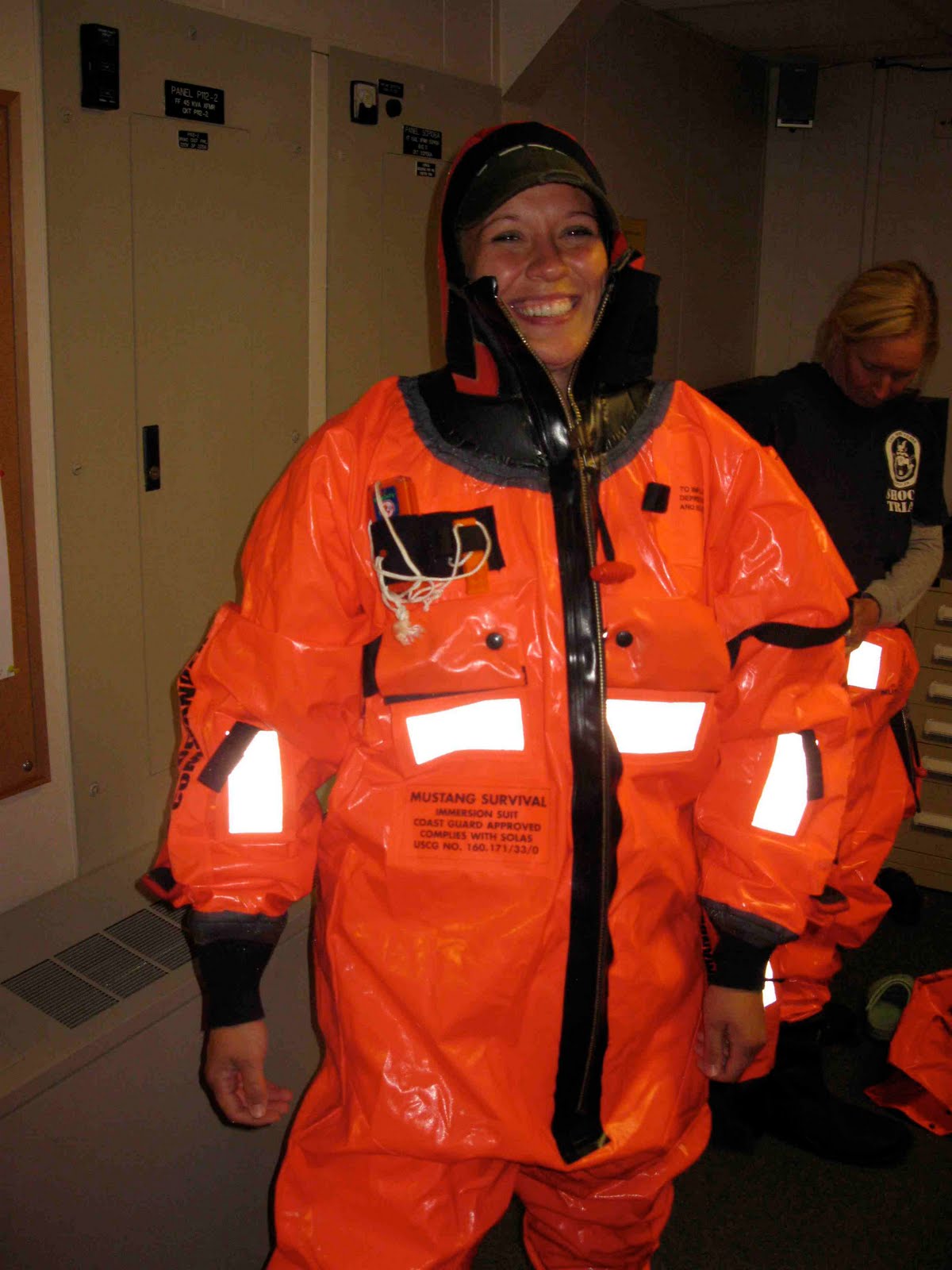
Me trying on my "Gumby" Suit during the fire drill

The entire crew participated in a fire drill and abandon ship drill yesterday so that all hands on the ship knew where to muster for a head count and to learn how to operate the life rafts in case the ship was sinking. Additionally we needed to learn how to get into our survival suits (Gumby Suits). My first experience putting on the suit was during a field trip onto this vessel with my seventh and eighth grade students in May so I was aware of the cozy fit! Fire and abandon ship drills are practiced once a week when the ship is underway, which is very important as the crew onboard are not just NOAA employees but also in charge of fighting fires and responding to any onboard emergencies. So, if you want to be a fireman and a scientist and cannot choose, perhaps serving aboard a NOAA ship would be right up your alley!
To end my day (remember bedtime for me is early as my alarm is set for 0330) I had a “late” supper of sushi, spring rolls, meatloaf, and for dessert a fabulous set of s’mores! Who says you can’t have them on the ship?


Animals Observed:
Northern Fulmar
Crested Auklets
Tufted Puffin

Black-legged Kittiwake
Orcas

Something to Ponder:

When we are asked, “What do you want to be when you grow up?” usually we say one occupation - firefighter, actor, scientist, teacher, soldier, waitress. However, most jobs require many skills. For example, the scientists on board put a variety of skills into practice and as mentioned in the Scientific Log, scientist Kresimir Williams engineered the Cam-Trawl which employed his knowledge of the biological sciences (fish/oceanography), physical science (how to deploy the device without it breaking), and photography! So for my students, what do you want to be when you grow up?


Wednesday, July 21, 2010

Blog #1 7/20/2010

NOAA Teacher at Sea: Story Miller
NOAA Ship: Oscar Dyson
Mission: Summer Pollock III
Geographical Area: Bering Sea
Date: July, 20, 2010
Time: 1240
Latitude: 53°51N
Longitude:166°34W
Wind: 7 knots (approx. 8.055mph)
Direction: 202° (SW)
Sea Temperature: 9.22°C (approx. 48.596°F)
Air Temperature: 9.82°C (approx. 49.676°F)
Barometric Pressure (mb): 1023.8
Scientific Information
Figure 1: View of the low fog, clouds and sunset in Dutch Harbor the night of the delay.


What Is NOAA and How Can You Get Involved?
NOAA stands for the National Oceanic and Atmospheric Association and is part of the United States Department of Commerce. NOAA is involved around the world and there are many different avenues one could become involved with. For example, some people are involved in forecasting the location of the next hurricane strike, which means that you could be responsible for saving the lives of people living in those areas. If climate change is of a particular interest, you could aid in the monitoring of global weather systems to make climate predictions for the future. If ecological studies suit you, a job with NOAA could involve collecting data from costal environments to continue efforts of preserving healthy ecosystems. Perhaps your studies and data analysis would aid in the critical decision making processes of businesses around the world, such as creating and enforcing policies for the fisheries industry to maintain its resources for the future.  Mapping is equally important and part of your experience with NOAA could involve creating or enhancing navigational data to aid in the protection of ships and prevent potential accidents. Finally, perhaps you are interested in commanding a NOAA ship or piloting a NOAA aircraft. In that case, you could become part of the NOAA Corps.

The Mission
The primary mission of the Oscar Dyson is the Walleye Pollock survey, which consists of conducting Acoustic Surveys and Fishery Survey Trawls. The acoustic survey relies on sonar waves that are powerful enough to detect fish at different depths. Once the fish is located on the sonar screen, the trawl net is then accurately deployed to a specific depth depending on where the targeted fish species are located. This depth can range from 16 meters from the surface all the way down to 3 meters from the bottom.  The net is then hauled onto the ship’s aft deck and the contents are spread on the table in the lab for sorting and identification. Different species, such as the Walleye Pollock, will be measured for size, sex, and age before being released overboard. Some other species like Pacific Cod and Arrowtooth Flounder will be collected for additional studies.

Delays, Delays!
    Monday, July 19th appeared to be a rare, sunny day in Dutch Harbor for most of the afternoon. We were scheduled to leave Dutch Harbor at 1500h but due to baggage problems for those who recently arrived in Dutch Harbor, we were delayed until the next day. Because of the short airstrip in Dutch Harbor, the sizes of the airplanes are smaller than those of regular airports. Currently Pen Air uses SAAB Turboprop airplanes. These planes are small and hold about thirty passengers. They are typically used for small air carriers for short commutes.  Another critical factor involved with flights is weight. For every passenger, think of the additional weight of all the bags each person has. Most people fly with one or two bags, each weighing 50lbs or less and in our case, some people also had additional bags carrying scientific equipment.
Figure 2: A typical foggy day in Dutch Harbor, Monday, July 19th, 2010
Weight in an airplane causes the plane to use more fuel and smaller airplanes cannot carry as much fuel as the other airplanes, such as Boeing 737 aircraft, commonly used for longer commutes by larger airlines. Because of the distance between Anchorage and Dutch Harbor, full flights generally need to make a stop in the small villages of King Salmon or Cold Bay to refuel. Other difficulties faced by the airport in Dutch Harbor are that the airstrip is a “daylight only” landing zone and the weather can be quite hazardous. Winds reaching up to 90 mph are not uncommon and in the summer, low fog becomes a visibility issue. If the pilots do not have a specific range of visibility, they cannot land. Therefore, the necessity of refueling in Cold Bay or King Salmon is critical because many times when the plane reaches the airport and hazardous weather conditions are preventing a safe landing, the airplane must have enough fuel to circle the airport in hope for a sliver of time when landing conditions are safe and, if necessary, enough fuel to fly all the way back to King Salmon or Cold Bay. Again, weight is an issue in the fuel consumption of an airplane and therefore, on full flights, the airplane must sometimes “bump” bags, which means that sometimes your checked bag will not make it on the flight you are on and will be scheduled on a later flight. This of course isn’t a bad plan except that the weather in Dutch can change from one extreme to the next in a matter of fifteen minutes. In our case, to add to the difficulty of getting our bags, it was explained to us that because the air had become warmer, it lessened the lift on the airplane which was another reason why the planes did not carry very many bags that day. With all these important technicalities, one could maybe understand why flying into Dutch Harbor can be difficult. Therefore, some people have successful flights and others experience the “flight to nowhere” which involves flying part or the entire three hours to Dutch Harbor, circling or waiting in Cold Bay, and then flying back to Anchorage. One could say that you are not a local until you have experienced this situation a few times!
Personal Log:
My first day on the boat proved to be interesting as I quickly learned my way around the ship. I sometimes make the analogy of myself being like a rat in a maze trying to find the cheese. In a way it is accurate because the cook on board has made some fantastic dinners and I’ve been successful at finding the mess hall by simply following my nose! For supper on Monday night, we had a buffet-style dinner and I was pleasantly surprised with the menu as I helped myself to prime rib and king crab legs!
Figure 3: Me in front of the Oscar Dyson, Monday, July 19th, 2010 (notice the extreme weather change!) 


On Tuesday, we were able to get underway at approximately 1300. Before pulling away from the dock, we needed to test our FRB (Fast Rescue Boat) to make sure it was functional in the possible event of an emergency. Once we knew the FRB was functional, we hauled it back onto the boat. As soon as we began to move, I went to the flying bridge (the highest deck on the ship) to catch a glimpse of Dutch Harbor and to watch the local birds sitting on the water. Most of the birds I saw were tufted puffins. I always find them amusing because if you get near them when they have eaten too many fish, they try to fly away but their belly is too heavy. Therefore they simply skim over the water, wings flapping intensely, and bellies dragging over the top of the water!
Figure 4: Lead Fisherman Dennis Boggs and Skilled Fisherman Mike Tortorella testing the FRB

Some advances in healthcare that I am extremely excited about is that I have found a seasickness medication that does not knock me out in under 5 minutes and that works for a long period of time. Thank you Meclizine!
    Currently we are underway and have approximately 381 miles northwest to travel before we make our waypoint which will take approximately 28 hours. As of right now, my job has been to get acclimated to the ship. Work will begin Thursday at sunrise, about 0700).  My current shifts will run from 0400h to 1600h each day. I cannot wait to begin the first part of my assignment!
   

Animals Spotted By Me Today:
Blackfooted Albatross
Tufted Puffin
Seagull
Sea Otter
Fur Seal

Something To Ponder:
Regarding NOAA fish surveys, such as the Pollock Survey I’m participating in, what impacts would the scientific information collected have on the fishery industry regarding revenue and long term success?

Tuesday, July 13, 2010

Pre-Cruise Info!


Hello Everyone!
Looks like you have made it to my page! Here, you'll be able to track what I am doing aboard the Oscar Dyson from July 19 - Aug 6th. You can also track my daily position in the Bering Sea by following this link: http://shiptracker.noaa.gov/
From there you can look at the position of all NOAA ships or simply follow mine via "Oscar Dyson" (DY) and "Current Cruise."

I encourage everyone to swamp me with questions you may have as you read my blogs. My goal is that everyone can learn from this and share in part of the fun, and if you are one of my students, you will be ahead of the game as we will be using the research I am conducting in my classroom this year! Have fun!
-Miss Miller